Pool Chemical Dosing Cheat Sheet (Per 10,000 Gallons)
One master pool dosing table: how much liquid chlorine, cal-hypo, dichlor, stabilizer, baking soda, soda ash, muriatic acid, salt, and calcium chloride to add per 10,000 gallons.
Quick answer (per 10,000 gallons): raise free chlorine 1 ppm with about 10 fl oz of 12.5% liquid chlorine; raise CYA 10 ppm with 13 oz of stabilizer; raise TA 10 ppm with 1.5 lb baking soda; raise pH about 0.2 with 6 oz soda ash; lower pH about 0.2 with 12 fl oz muriatic acid; raise salt 1,000 ppm with 83 lb salt; raise CH 10 ppm with about 1.2 lb calcium chloride. Scale to your pool, and always test before re-dosing.
Safety first, every time. Never mix pool chemicals, especially different chlorine types or chlorine and acid, because the reaction can release toxic gas or heat. Always add the chemical to the water, not water to the chemical. Pre-dissolve or broadcast per the product label, run the pump while dosing, add one chemical at a time, and retest before adding more. Store chemicals separately, sealed, and away from children and pets. These figures are estimates from standard pool-care formulas, so test your own water and follow your product labels.
This is the one table to bookmark. It pulls together the standard doses for every common pool chemical, all sized to a tidy 10,000-gallon reference so you can scale to your pool with simple multiplication. Confirm your real volume first with the Pool Volume Calculator, then read across the sheet for the adjustment you need. Each figure is an approximation based on widely used pool-care formulas, so treat it as a strong starting point and let your test kit confirm the result.
Master dosing table (per 10,000 gallons)
| Goal | Chemical | Amount per 10,000 gal | Notes |
|---|---|---|---|
| Raise FC +1 ppm | Liquid chlorine (12.5%) | ~10 fl oz | No CYA added; best daily sanitizer |
| Raise FC +1 ppm | Liquid chlorine (10%) | ~13 fl oz | Weaker, so use a bit more |
| Raise FC +1 ppm | Cal-hypo (73% available) | ~2 oz weight | Adds calcium; pre-dissolve fully |
| Raise FC +1 ppm | Dichlor (56% available) | ~2.4 oz weight | Adds ~0.9 ppm CYA per 1 ppm FC |
| Raise FC +1 ppm | Trichlor (90%) tablet | ~1.5 oz | Adds CYA, lowers pH; slow dissolving |
| Raise CYA +10 ppm | Cyanuric acid (stabilizer) | ~13 oz (0.8 lb) | Dissolves slowly; use a sock in the skimmer |
| Raise TA +10 ppm | Baking soda (sodium bicarbonate) | ~1.5 lb | Minimal effect on pH |
| Raise pH ~+0.2 | Soda ash (sodium carbonate) | ~6 oz | Also nudges TA up; varies with current pH |
| Lower pH ~-0.2 | Muriatic acid (31%) | ~12 fl oz | Also lowers TA; add to water near a return |
| Lower pH ~-0.2 | Dry acid (sodium bisulfate) | ~10 oz | Also lowers TA; adds sulfates over time |
| Raise salt +1,000 ppm | Pool salt (sodium chloride) | ~83 lb | For salt chlorine generator pools |
| Raise CH +10 ppm | Calcium chloride | ~1.2 lb (anhydrous) / 1.5 lb (dihydrate) | Pre-dissolve; releases heat as it dissolves |
To scale, multiply by your pool size in tens of thousands of gallons. A 20,000-gallon pool uses 2x each figure, a 15,000-gallon pool uses 1.5x, and a 5,000-gallon pool uses 0.5x. To raise a level by more than the listed amount, multiply again. For example, raising free chlorine by 4 ppm in a 20,000-gallon pool with 12.5% liquid chlorine is roughly 10 fl oz x 4 x 2, or about 80 fl oz.
Notes on each adjustment
Free chlorine
Liquid chlorine is the workhorse because it adds no calcium or stabilizer, just chlorine and a little salt. Cal-hypo adds calcium hardness, dichlor and trichlor add cyanuric acid, and trichlor also pushes pH down. Match the source to your pool: stabilized forms suit some routines but can build up CYA over a season. Size a shock dose with the Pool Shock Calculator and routine doses with the Chlorine Calculator.
Stabilizer (cyanuric acid)
CYA protects chlorine from sunlight. Aim for 30 to 50 ppm in a chlorine pool and 60 to 80 ppm in a salt pool. It dissolves slowly, so add it through a sock in the skimmer and allow several days before retesting. You can only lower CYA by draining and refilling. Dial it in with the CYA Calculator.
Alkalinity and pH
Baking soda raises total alkalinity with little pH movement, while soda ash raises pH and muriatic acid lowers both pH and alkalinity. Because they interact, adjust alkalinity into range first, then fine-tune pH. The pH and alkalinity adjustment chart expands these rows across pool sizes, and the pH & Alkalinity Calculator handles the interplay for you.
Salt and calcium
Salt is a one-way addition for generator pools; size it with the Salt Calculator and the Pool Salt Chart. Calcium chloride raises hardness toward the 250 to 350 ppm balanced range and releases heat as it dissolves, so add it slowly to a bucket of water, never the reverse.
Dose by the numbers, not by guessing
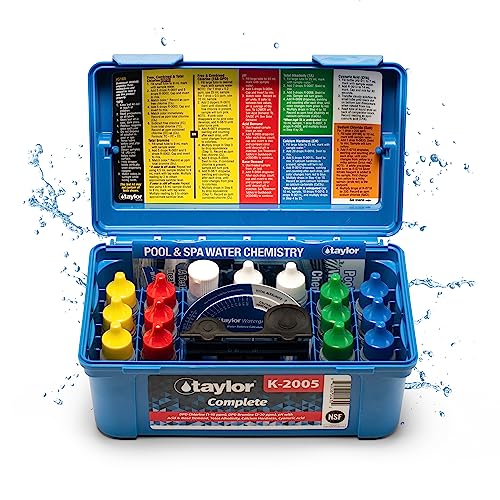
Taylor K-2005 Complete Pool Water Test Kit
Reagent drop test for FC, pH, TA, and CH so you dose to real readings.

In The Swim 3-Inch Stabilized Chlorine Tablets, 50 lb (Tri-Chlor)
Slow-dissolving trichlor tablets for steady chlorination in a feeder or floater.
Build a simple weekly routine
Test first, dose second, retest third. Most weeks you will adjust chlorine and pH, check alkalinity and stabilizer monthly, and touch calcium or salt only occasionally. Add chemicals in the evening when the sun is off the water, keep the pump running, and give slow dissolvers time before you read again. Keep this cheat sheet handy, scale every figure to your real gallon count, and respect the safety rules at the top. For target levels to dose toward, pair this sheet with the LSI Chart and our Water & Chemistry guides.
Frequently Asked Questions
How much liquid chlorine raises free chlorine in a pool?
About 10 fluid ounces of 12.5% liquid chlorine raises free chlorine by roughly 1 ppm in 10,000 gallons. Weaker 10% liquid chlorine needs about 13 fluid ounces for the same lift. To raise free chlorine by 5 ppm in a 10,000-gallon pool, you would use roughly 50 ounces, or about a quart and a half, of 12.5% liquid chlorine. Always retest before adding more.
Why is everything listed per 10,000 gallons?
Ten thousand gallons is a clean reference unit that scales easily. If your pool is 20,000 gallons, double the dose. If it is 15,000 gallons, multiply by 1.5. If it is 5,000 gallons, cut the dose in half. Start by confirming your true volume with a volume calculator, since builder estimates are often off, then scale every figure on this sheet to match.
Can I mix pool chemicals to save time?
Never. Mixing pool chemicals is dangerous. Combining different chlorine types, or mixing chlorine with acid, can release toxic chlorine gas, generate intense heat, or cause a fire. Add one chemical at a time, let the pump circulate it for the recommended period, retest, and only then add the next product. Use separate, clean buckets and never reuse a bucket between chemicals.
Do I add chemical to water or water to chemical?
Always add the chemical to the water, never water to the chemical. Pouring water onto a concentrated chemical like acid or cal-hypo can cause a violent reaction, splashing, or heat. When pre-dissolving in a bucket, fill the bucket with water first, then slowly add the measured chemical while stirring. Pour liquids slowly near a return jet with the pump running.
How do I lower calcium hardness, CYA, or salt?
You cannot remove calcium hardness, cyanuric acid, or salt with a chemical. The only practical way to lower any of them is dilution: drain part of the pool and refill with fresh water that has lower levels. That is why it pays to add these slowly and test as you go, since overshooting means a partial drain and refill to correct.
How long should I wait before retesting after dosing?
Run the pump and give the chemical time to circulate fully before retesting, generally at least 4 hours for most additions and longer for slow dissolvers like stabilizer and calcium. Liquid chlorine mixes within an hour or two of circulation. Retesting too soon gives a false low reading and tempts you to overdose, so be patient and let the water mix.
Taking care of a pool?
Use our free calculators and guides to get every number right.
Pool Care Planner: $39