How to Clear a Green Pool Fast
A step-by-step guide to clearing a green pool: test the water, balance pH, shock to the CYA-based shock level, brush, run the filter 24/7, and hold the level until it clears.
A green pool is an algae bloom, and the fix is chlorine: test the water, balance pH, then raise free chlorine to the shock level set by your cyanuric acid and hold it there while you brush and run the filter nonstop. The most common reason a green pool will not clear is shocking to a random amount instead of the CYA-based target, then letting chlorine fall before the algae is dead. Do it methodically and most pools clear in a few days. Here is the process.
Green Pool Recovery Gear

In The Swim 68% Cal-Hypo Granular Pool Shock
High-strength calcium hypochlorite shock to kill algae and clear green water.

Sepetrel 17.5" Pool Brush Head
Scrub algae off walls, floor, and corners so chlorine can reach it.

Clorox Pool&Spa Super Water Clarifier
Coagulates dead algae into clumps the filter can trap as water clears.
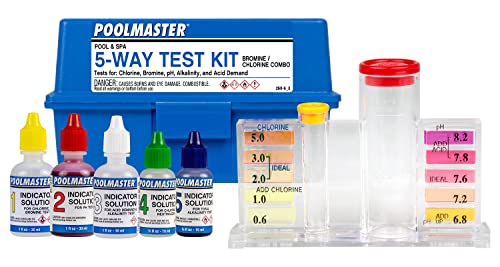
Poolmaster 5-Way Pool Water Test Kit
Read chlorine, pH, and acid demand so you shock to the right level.
Step 1: Test the water
Before adding anything, find out where you stand. The single most important reading for a green pool is cyanuric acid, because it sets how much chlorine you actually need.
- CYA: determines your shock target. A reading of 40 needs far less shock than a reading of 80.
- pH: chlorine works best near 7.2 to 7.6.
- Free chlorine: almost always low or zero in a green pool.
- Total alkalinity: note it so you can stabilize pH.
If your CYA is extremely high, say above 100, chlorine becomes so weak that no reasonable shock level clears the pool, and you may need to partially drain and refill first. Our guide to lowering CYA covers that, and the CYA calculator confirms your number.
Step 2: Balance pH
Adjust pH into the 7.2 to 7.6 range before shocking so the chlorine you add is as effective as possible. If pH is high, add muriatic acid with the pump running and let it mix. Use our pH and alkalinity calculator for the dose. Do not chase perfect alkalinity right now; getting pH into range is enough to let the shock work.
Step 3: Shock to the CYA-based level (SLAM)
This is the core of clearing a green pool. The SLAM method, short for shock, level, and maintain, means raising free chlorine to the specific shock target for your CYA and holding it there until the algae is fully dead. That target is roughly 40 percent of your CYA reading, which is why testing CYA first matters so much.
Use our shock calculator with your gallons and CYA to get the exact shock target and dose, and read the full method in our how to shock a pool guide. Our green pool water help page walks through the same recovery if you want a troubleshooting view, and pool algae explains the different algae types.
Safety basics that are mandatory:
- Never mix pool chemicals. Keep shock, tablets, and acid completely separate and never combine them in a bucket, feeder, or scoop.
- Always add chemical to water, never water to chemical. Pre-dissolve or broadcast granular shock per the label over the deep end.
- Run the pump while dosing so chlorine disperses instead of settling.
- Add the first big dose at dusk so sunlight does not burn it off, then keep topping up day and night.
- Store chemicals dry, separated, and away from kids and pets, and keep everyone out of the pool during a SLAM.
Step 4: Brush the whole pool
Brush the walls, floor, steps, and especially shaded corners and behind ladders right after shocking and again daily. Algae clings to surfaces and forms a protective layer, so brushing breaks it up and exposes it to the chlorine. Skipping this leaves living algae shielded on the surfaces no matter how much shock you add.
Step 5: Run the filter 24/7
Run the pump and filter continuously, 24 hours a day, for the entire recovery. The filter is what physically removes the dead algae after the chlorine kills it. As the green turns to cloudy white or gray, that is dead algae suspended in the water, a sign the treatment is working.
- Clean or backwash the filter whenever pressure rises about 8 to 10 psi above clean, which will be often during a green-pool cleanup.
- Add a clarifier to help the filter grab fine dead-algae particles and speed up clearing.
- If you have a lot of debris on the bottom, vacuum to waste, then top the water back off.
If your pump struggles to turn the water over, confirm it is sized right with our pump size calculator.
Step 6: Maintain the level until clear
Test free chlorine several times a day and re-dose back up to the shock target each time it falls. Early in the cleanup the algae eats chlorine fast, so you may add shock two or three times a day. Hold the level until three things are all true:
- Free chlorine holds overnight with little loss, meaning the algae demand is gone.
- Combined chlorine is at or below about 0.5 ppm.
- The water is clear and you can see the bottom plainly.
| Stage | What you see | What to do |
|---|---|---|
| Start | Green, cloudy water | Test, balance pH, shock to CYA target |
| Working | Turning cloudy white or gray | Algae dying; keep shocking and brushing |
| Clearing | Cloudy but lighter | Filter 24/7, add clarifier, hold level |
| Done | Clear, FC holds overnight | Confirm CC under 0.5, then resume normal care |
Keep it from happening again
Once clear, let free chlorine drift back to your normal range before swimming, and retest everything. Green pools almost always come from chlorine running low for a few days, so the prevention is consistency: hold the right free chlorine for your CYA daily, keep CYA in range, brush weekly, and shock after storms or parties. Lock in the habit with our weekly pool maintenance routine and your pool should stay clear all season.
Pool Care & Maintenance Planner
Water-test log, chemical dosing tracker, weekly maintenance schedule, and opening and closing checklists, in one printable planner that keeps your pool clear all season.
Frequently Asked Questions
How long does it take to clear a green pool?
A light green pool often clears in 1 to 3 days, while a deep green or black-green pool can take 5 to 7 days or longer. The keys are holding a high shock level around the clock, brushing daily, and running the filter 24 hours a day. Skipping the retest-and-redose cycle is what makes most green-pool fights drag on.
Why is my pool green even though chlorine is high?
High chlorine on a strip can read full while the pool is actually consuming chlorine faster than you add it, or your cyanuric acid is so high that the chlorine is mostly inactive. The fix is to test CYA, calculate the correct shock target for that CYA, and hold it. Very high CYA may require partial draining before shock can work.
Should I use algaecide or shock for a green pool?
Chlorine shock is what actually kills the algae and clears the water; that is the main treatment. Algaecide is a supporting product, useful for prevention and for stubborn types, but it is not a substitute for shocking to the correct level. Clear the pool with shock first, then consider algaecide as ongoing prevention once the water is clean.
Do I need to balance pH before shocking a green pool?
Yes. Chlorine works far better when pH sits near 7.2 to 7.6, so test and adjust pH before you shock. Shocking into high-pH water wastes chlorine and can cloud the pool. Lower pH with muriatic acid if it is high, let it mix with the pump running, then proceed to your shock dose.
My pool turned cloudy white after shocking. Is that bad?
No, that is usually a good sign. Cloudy white or gray after shocking a green pool means the algae is dead and now suspended in the water as fine particles. Keep the filter running 24 hours a day, brush, and add clarifier to help it trap the particles. The cloud clears as the filter removes the dead algae.
How do I keep my pool from turning green again?
Hold free chlorine in the correct range for your CYA every day, keep CYA in range so chlorine stays effective, brush weekly, run the pump enough to turn the water over daily, and shock after storms or heavy use. Most green pools come from chlorine running low for a few days, so consistency is the real prevention.
Taking care of a pool?
Use our free calculators and guides to get every number right.
Pool Care Planner: $39