How to Open a Pool (Spring)
A step-by-step spring pool opening guide: remove and clean the cover, top off, reconnect equipment, test and balance, shock, and run the filter until the water is clear.
Opening a pool in spring comes down to seven steps: pump the water off the cover and remove it, top the pool off to the right level, reconnect and prime your equipment, test and balance the water, shock it, then run the filter around the clock until it clears. Do it early while the water is still cool and you avoid the green-pool battle entirely. Below is the full routine, plus the calculators that get your numbers right the first time.
Pool Opening Essentials

In The Swim Pool Basic Opening Chemical Start Up Kit
Bundled shock, clarifier, algaecide, and scum absorber to start the season clear.
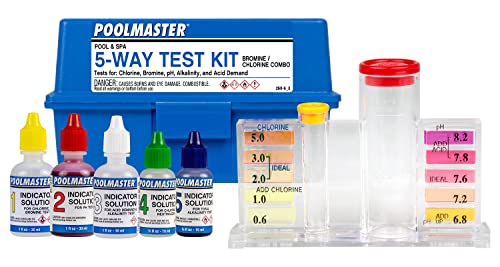
Poolmaster 5-Way Pool Water Test Kit
Reads chlorine, pH, alkalinity, and acid demand so you can balance correctly.

In The Swim 68% Cal-Hypo Granular Pool Shock
Strong calcium hypochlorite shock to oxidize the water on opening day.

Doheny's Ultimate Pool Opening Start-Up Kit
Metal out, algae control, clarifier, and sun sorb for a deluxe opening.
Step 1: Pump off and remove the cover
Before you touch the cover, clear the standing water and debris sitting on top of it. A winter cover collects rain, leaves, and grime all season, and you do not want any of that washing into the pool.
- Use a cover pump or a submersible pump to remove the puddle of water on the cover.
- Sweep or skim off leaves and debris once the surface is dry enough to work on.
- With a helper, peel the cover back slowly so debris slides off the edge, not into the water.
- Lay the cover out on the lawn or driveway, hose it down, let it dry fully, then fold and store it somewhere dry. A clean dry cover lasts years longer.
Step 2: Top off the water level
Winterizing usually means the water was dropped below the skimmer. Refill with a garden hose until the level reaches the middle of the skimmer opening, the normal operating height. Do not drain and refill the whole pool unless your cyanuric acid is far too high, because draining a pool risks floating a liner or popping the shell. Knowing your exact gallons matters for every chemical you add next, so confirm it with our pool volume calculator.
Step 3: Reconnect and prime your equipment
Reinstall everything you removed at closing and get water moving again.
- Reinstall drain plugs in the pump, filter, heater, and any chlorinator. Missing plugs are the number one cause of opening-day leaks.
- Put the skimmer baskets, return fittings or eyeballs, and pump basket back in place.
- Reconnect the filter, then remove any winterizing plugs or pool antifreeze from the lines by letting it flush out to waste if your valve allows.
- Prime the pump by filling the basket with water, then power it on and watch for full flow with no air. Check for leaks at every union and plug.
If you are unsure your pump can turn the water over fast enough, our pump size calculator shows the flow rate you need to cycle the whole pool in about eight hours.
Step 4: Test and balance the water
Run the pump for at least a few hours to mix the water, then take a full test. Balance in this order, because each reading affects the next.
- Total alkalinity (TA): aim for 60 to 120 ppm. TA buffers pH, so set it first. Raise it with baking soda, lower it with muriatic acid.
- pH: aim for 7.2 to 7.8. Lower with muriatic acid, raise with soda ash. Get it near 7.4 before shocking.
- Cyanuric acid (CYA): aim for 30 to 50 ppm in a chlorine pool. CYA protects chlorine from the sun and sets your shock target. Check it with our CYA calculator.
- Calcium hardness (CH): aim for 200 to 400 ppm to protect surfaces and equipment.
Work through the full sequence with our pool water balance guide if any reading is off. The table below is your spring target sheet.
| Reading | Ideal range | Raise with | Lower with |
|---|---|---|---|
| Total alkalinity | 60 to 120 ppm | Baking soda | Muriatic acid |
| pH | 7.2 to 7.8 | Soda ash | Muriatic acid |
| Free chlorine | Set by CYA | Chlorine or shock | Sunlight, time |
| Cyanuric acid | 30 to 50 ppm | Stabilizer | Dilution only |
| Calcium hardness | 200 to 400 ppm | Calcium chloride | Dilution only |
Step 5: Shock the pool
With alkalinity and pH balanced, raise free chlorine to a shock level to kill anything that grew over winter and oxidize organic buildup. The right shock target depends on your CYA, not a fixed amount, so plug your gallons and CYA into our shock calculator for the dose. For ongoing daily chlorine targets, the chlorine calculator sets your maintenance level.
Safety basics that are not optional:
- Never mix pool chemicals together. Keep shock, tablets, and acid in separate containers and never combine them in a bucket or feeder.
- Always add chemical to water, never water to chemical. Pre-dissolve granular shock per the label or broadcast it slowly over the deep end.
- Run the pump while you dose so chemicals disperse instead of settling on the floor.
- Shock at dusk so the sun does not burn off your dose before it works, then retest before re-dosing.
- Store chemicals separately, dry, and away from kids and pets.
Step 6: Run the filter and clear the water
After shocking, run the pump continuously, ideally 24 hours a day, until the water turns clear. Brush the walls and floor to lift any settled dust and dead algae into the water where the filter can catch it. Clean or backwash the filter whenever the pressure gauge climbs about 8 to 10 psi above its clean starting point.
If the water is cloudy but balanced, a clarifier helps the filter trap fine particles. If it opened green, switch to our green pool recovery steps and hold a shock level until it clears. Once the water is sparkling and free chlorine has dropped back to your normal range, retest everything one last time and you are ready to swim.
Quick spring opening checklist
- Pump off the cover, remove, clean, dry, and store it.
- Top off to mid-skimmer; confirm gallons with the volume calculator.
- Reinstall plugs, baskets, and fittings, then prime the pump.
- Test and balance TA, pH, CYA, and CH.
- Shock to your CYA-based target at dusk with the pump running.
- Run the filter 24/7, brush, and clarify until clear.
- Retest and swim.
Pool Care & Maintenance Planner
Water-test log, chemical dosing tracker, weekly maintenance schedule, and opening and closing checklists, in one printable planner that keeps your pool clear all season.
Frequently Asked Questions
When should I open my pool in spring?
Open once daytime temperatures are consistently in the 65 to 70 degree range, usually mid to late spring. Opening earlier while the water stays cold actually helps, because algae grows slowly below about 60 degrees. Waiting until the water is warm and green makes the job much harder, so it is better to uncover and balance early rather than late.
Should I drain my pool to open it?
In most cases no. Draining risks a vinyl liner floating or a pool popping out of the ground from groundwater pressure, and it wastes water and chemicals. Top off to the middle of the skimmer instead and balance what you have. Only drain partially if your cyanuric acid is far too high, since dilution is the only way to lower CYA.
How long does it take to clear a pool after opening?
A pool that was clean at closing usually clears in 1 to 3 days after you balance, shock, and run the filter continuously. A pool that was left green or that sat under a leaky cover can take a week or more of shocking, brushing, and filtering. Running the pump 24 hours a day and cleaning the filter often speeds it up.
Do I balance the water before or after shocking?
Balance first. Adjust total alkalinity, then pH, and check cyanuric acid before you shock. Shocking works best when pH sits near 7.2 to 7.6, and a correct CYA reading tells you the right shock target. Adding shock to badly balanced water wastes product and can cloud the water or scale surfaces, so get the basics right first.
Why is my pool still cloudy after opening?
Cloudy water after opening usually means the filter has not caught up, the water is not fully balanced, or you have early algae the shock has not finished. Keep the pump running 24 hours a day, clean or backwash the filter as pressure rises, hold a shock level, and add clarifier if needed. Our cloudy water guide walks through each cause.
Can I swim right after opening the pool?
Wait until the water is clear, balanced, and free chlorine has fallen back into your normal range, typically below about 5 ppm depending on your CYA. After a spring shock that often means waiting until the next day. Always test free chlorine and pH before anyone gets in, since swimming in freshly shocked water can irritate skin and eyes.
Taking care of a pool?
Use our free calculators and guides to get every number right.
Pool Care Planner: $39